
Trade show marketing strategy for participants of international trade shows
How to pay back participation in an international trade show: the stand as a funnel, meetings before the opening, the show app, work on site and follow-up afterwards.
» Key points in 30 seconds
- A trade show pays back through meetings booked in advance, not the traffic of the hall.
- The stand is designed as a funnel: the visitor's route, a demo, a negotiation zone.
- The stand - six months before the opening, the marketing strategy - four months before.
- The show app is a database of people who have already bought tickets.
- The follow-up plan is prepared before the show, not after it.
Contents · 6 sections
An international trade show is the most expensive few days in the marketing calendar of a B2B company. The space, the construction, the logistics and the team cost so much that it is almost impossible to pay them back with a random flow of visitors. A trade show pays back in a different way: with meetings agreed in advance and with work on the contacts after the hall closes. Below are the four parts of a complete approach - the stand, communication before the show, work on site and work afterwards - and the calendar by which to launch them.
A stand is a funnel, not a showcase
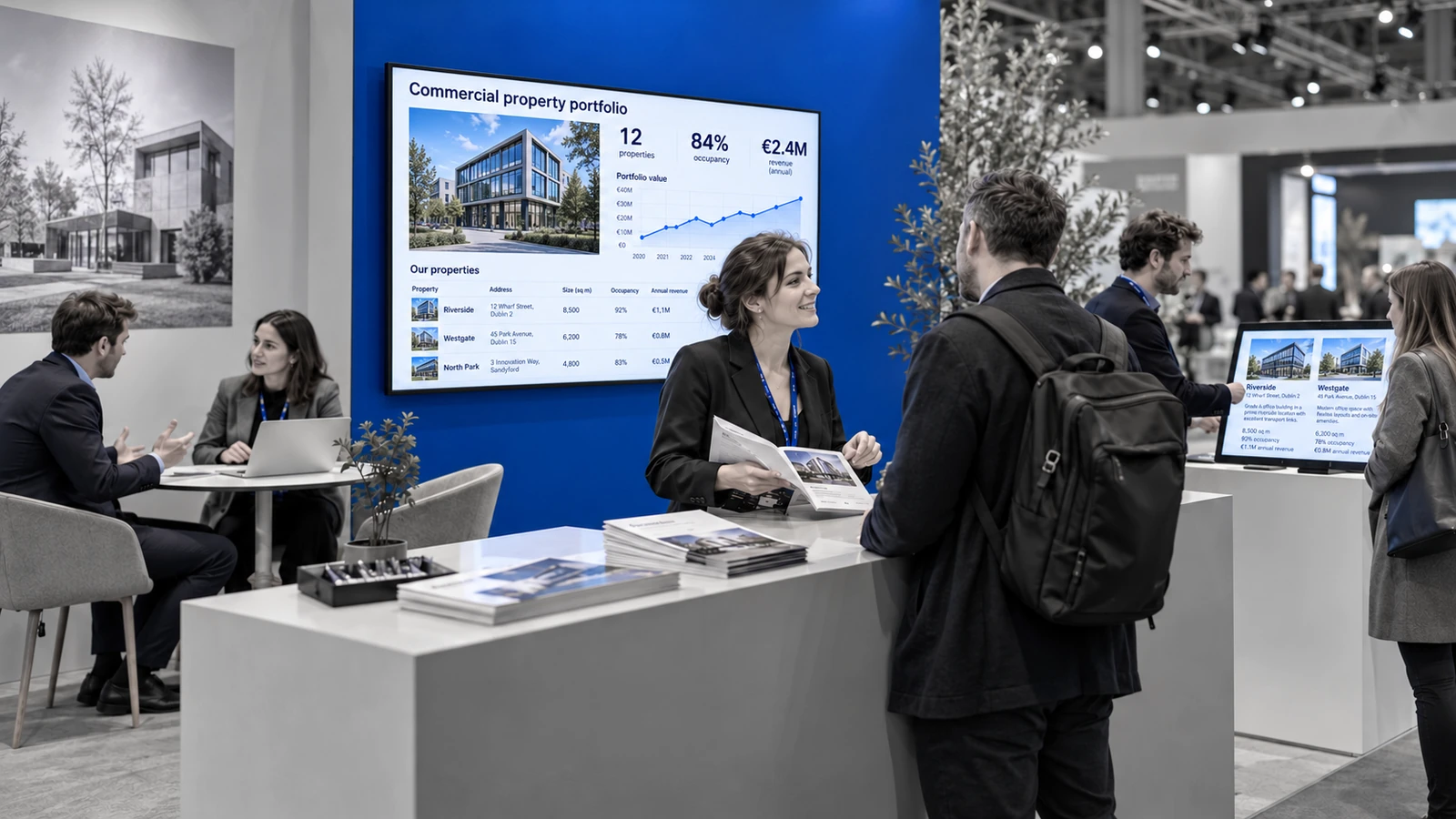
The stand is the face of the company at the show, but a beautiful stand does not sell by itself. It is designed as a funnel: where a visitor enters from, what they see first, where they stop, who talks to them and what they get on the way out - a brochure, a demo or a booking for a meeting. The products are placed along this route, the competitive advantages at eye level, and a separate quiet zone is kept for negotiations. If the customer's route through the stand has not been planned, the team spends the whole day serving random people while the right guest walks past.
Meetings are booked before the opening
The main mistake of exhibitors is to count on the traffic of the hall. It is much more reliable to come to the show with a calendar of meetings: with current clients and partners, with leads stuck in the funnel, and with new companies that have already bought tickets. For this, participation is promoted through several channels at once: LinkedIn outreach to decision-makers, email to the database, advertising to contact lists, posts and the show's event on LinkedIn. Building an expensive stand and ignoring online warm-up of the audience is the same as opening a shop and not telling a single customer about it.
- 01LinkedIn outreach to decision-makers
- 02Email to your own database and the database of participants
- 03Advertising to contact lists
- 04The show's event and posts on LinkedIn
Trade show marketing strategy: calendar six months before the opening
For confident participation we advise starting at least six months ahead: that is how long choosing the space, designing and building the stand take. The marketing strategy - audience, messages, channels and budget - is launched four months before the event. First you select a quality database of target companies and decision-makers (how to build it), then you build touchpoints through inbound and outbound, and only then do you launch outreach and advertising on that database. Measure every hypothesis: how many replies, how many meetings and from which segments. The detailed calendar is in the breakdown of preparing for an international trade show.

PREPARATION CALENDAR

The show app is a database of ready buyers

Most big shows have their own mobile app for communication and scheduling meetings. Find it right away or ask the organizers whether it exists. It is installed first by people who have already bought tickets, that is, your hottest potential clients: they will definitely be in the hall and are looking for someone to meet. A user profile often has a job title, a company and even LinkedIn, so the offer can be prepared for a specific person before the first message. Write as personally as on LinkedIn: who you are, why you are writing to this person and what you suggest talking about at the stand.
More than the stand works during the show
The stand is not the only place where sales happen. Seminars, panel discussions, presentations and networking events around the show gather exactly the people who make decisions, and in an informal setting it is easier to start a conversation with them. A talk or taking part in a discussion shows your expertise better than any banner. Plan these events the same way as meetings at the stand: who from the team goes, who they want to talk to and what they offer. Record every new contact immediately, with the context of the conversation and the agreement on the next step, while the details are not forgotten.
The show does not end on the day of teardown
A lot of the value of a trade show is lost in the first days after it. Contacts sit in phones and business card holders, managers go back to current tasks, and the new acquaintances meanwhile manage to talk to competitors. That is why the follow-up plan is prepared before the show: who we write to and what, on which day, who answers. The second part of the work is analysis: how many meetings were planned and how many took place, how many deals appeared, which segments responded, what worked at the stand and what did not. These conclusions are a ready brief for the next show.
EXHIBITOR CHECKLIST
- 01Six months ahead: space, stand design and construction
- 02Four months ahead: database, strategy and channels
- 03Before the opening: the meeting calendar is full
- 04After the show: follow-up by a ready plan
Whoever waits for clients at the stand gets the people who walked past.Whoever booked meetings in advance gets the people they chose themselves.
 Whoever waits for clients at the stand gets the people who walked past.
Contents
» EXHIBITION DIRECTION
Marketing and the stand - in one pair of hands.



New - first in the channels.
A new article or breakdown comes out here first. Pick the network that suits you.
LINKED PROMO
FOUNDER · VOLODYMYR MOSKALYUK
Comments
No comments yet. How many meetings were in your calendar before your last trade show?